🔥 ₹425 VALUE @ ₹399 + FREE DELIVERY 🚚 | 🔥 PAY ₹500 & GET ₹600 MRP + FREE DELIVERY 🚚 | 💰 EXTRA 10% OFF ON UPI PAYMENTS
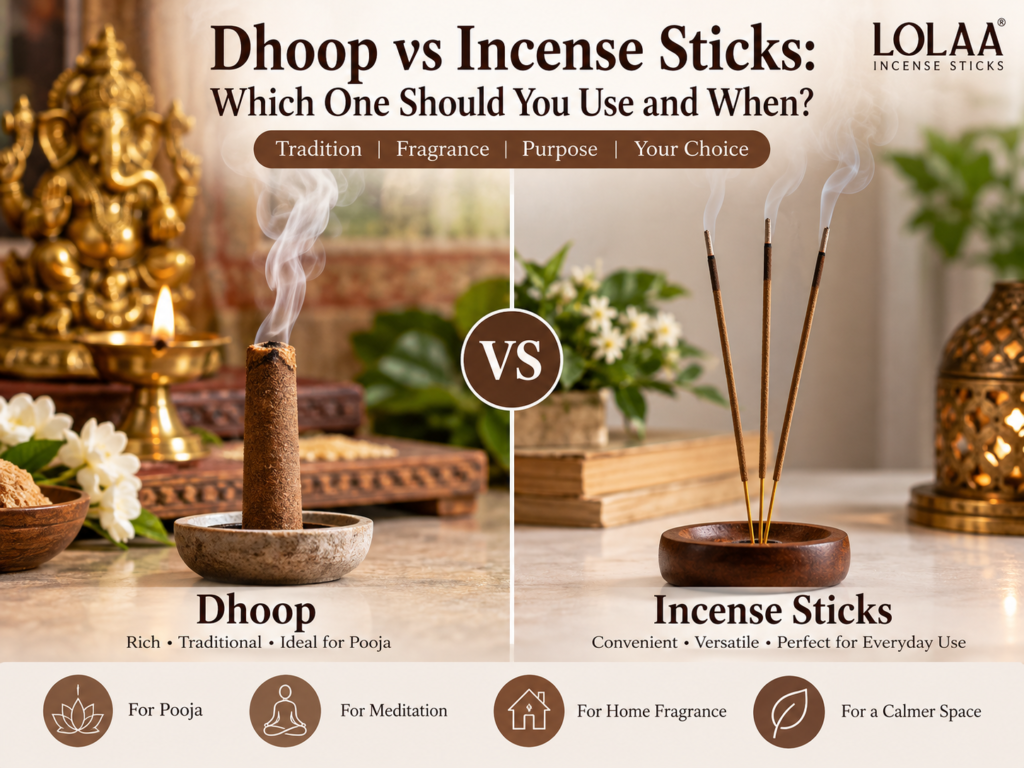
Dhoop vs Incense Sticks: Which One Should You Use and When?

Dhoop vs incense sticks is an important comparison for anyone choosing fragrance products for prayer, pooja, meditation or everyday home ambience. Both are designed to release aroma when burned, but they can differ in their physical form, composition, fragrance intensity, smoke output and the way the aroma develops inside a room. Incense sticks are commonly available as slender sticks, frequently with a bamboo core, while dhoop may appear as thicker sticks, cones, cups or other bamboo-free formats depending on the manufacturer and product.
Understanding dhoop vs incense sticks becomes more useful when you focus on how you intend to use them. Someone looking for a richer traditional fragrance during pooja may have different preferences from a person who wants a subtle aroma in a bedroom, reading corner or living room. Neither format is automatically better for everyone. Fragrance style, room size, ventilation, burn consistency and personal preference all influence the experience, which is why the right choice should be based on the actual product rather than only its name.
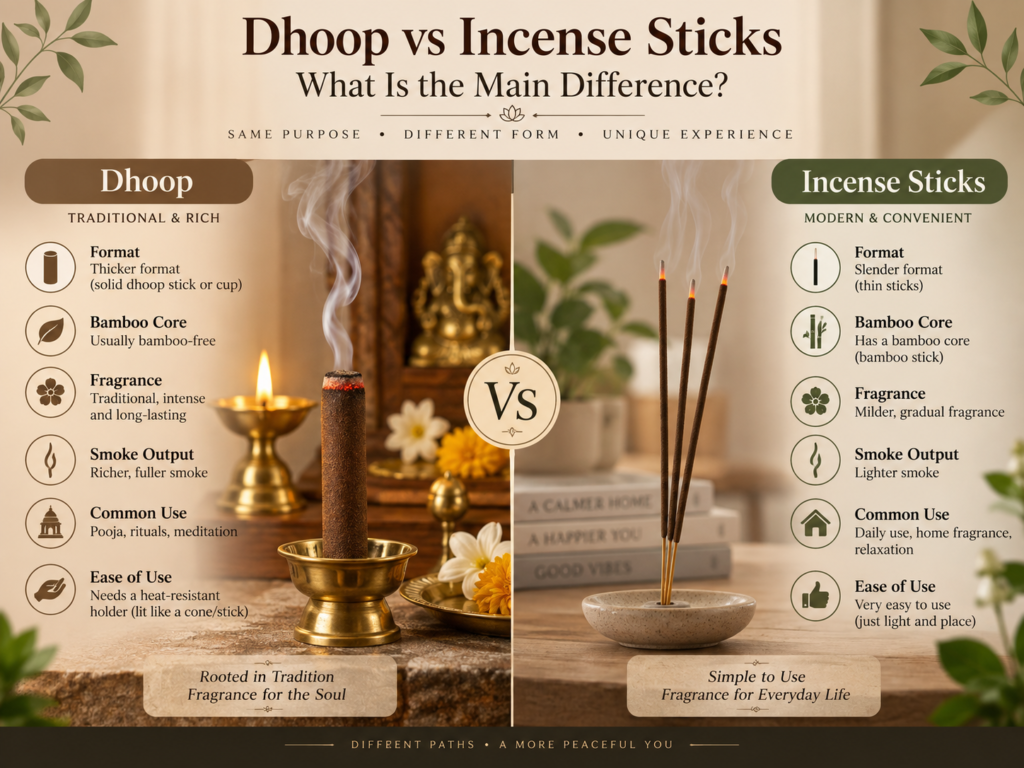
Dhoop vs Incense Sticks: What Is the Main Difference?
The basic dhoop vs incense sticks difference begins with product format. Traditional incense sticks commonly consist of a thin bamboo core coated with a combustible aromatic mixture. When lit, the coated portion slowly smoulders and releases fragrance. This familiar format is widely used in homes, prayer rooms and commercial spaces because the stick is easy to handle, place in a holder and burn for a gradual fragrance experience.
Dhoop is a broader traditional fragrance format that may be produced without a bamboo core. It can appear as thick dhoop sticks, cones, logs, cups or paste-based products. Because there is often more aromatic combustible material in the burning portion, some dhoop products can provide a fuller fragrance and a different smoke experience. However, this should not be treated as a universal rule because formulas, dimensions and manufacturing methods vary significantly between brands.
When comparing dhoop vs incense sticks, consider how quickly you want the fragrance to become noticeable and how much space you are scenting. A stronger dhoop product may feel appropriate in a well-ventilated pooja area, while a lighter incense stick may be easier to use in a compact room. The broader incense vs dhoop comparison therefore involves fragrance intensity, product construction, smoke preference and intended use rather than simply deciding that one category is superior.
Another useful point in the dhoop vs incense sticks discussion is convenience. Incense sticks usually require a narrow holder and are easy to light individually. Dhoop formats may require a broader heat-resistant base depending on their shape. Buyers should always follow the instructions supplied with the individual product and make sure burning products are positioned safely away from curtains, paper, children, pets and other combustible materials.
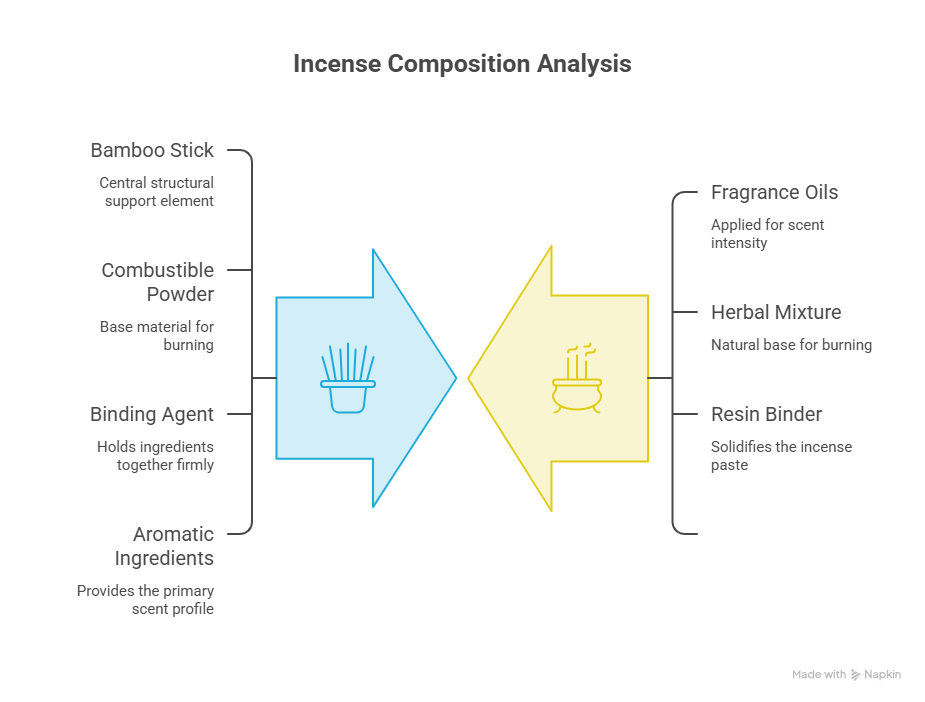
Dhoop Sticks vs Agarbatti: Ingredients and Manufacturing Explained
The dhoop sticks vs agarbatti comparison becomes clearer when you look at construction. Agarbatti commonly uses a bamboo stick as the central support, with a coating made from combustible powders, binding materials and aromatic ingredients. The exact formula varies by manufacturer. Fragrance may be introduced through aromatic materials incorporated into the mixture or through later fragrance application, depending on the production method.
Dhoop sticks are often made without a bamboo core, so a larger portion of what burns is the prepared aromatic material itself. When looking at dhoop vs incense sticks, this construction difference can affect thickness, burn behaviour, fragrance release and the type of holder required. Ingredients may include various wood powders, plant-derived aromatic materials, binding agents, charcoal-based components or fragrance compounds, but no single ingredient list should be assumed to apply to every product.
The phrase dhoop sticks vs agarbatti should therefore describe a product-format comparison rather than a rigid ingredient rule. Some incense is made using masala-style mixtures, while other products may use different coated or dipped processes. Dhoop may also be prepared in sticks, cones, cups or other forms. Buyers interested in ingredients should always review available manufacturer or packaging information rather than assuming that all dhoop or all agarbatti has the same composition.
From a buying perspective, dhoop vs incense sticks should be evaluated according to fragrance preference, manufacturing quality and intended use. Product consistency matters because an evenly produced stick or dhoop format should provide a predictable burning experience. Readers interested in the company and its manufacturing approach can also visit the LOLAA Incense Sticks About Us page for additional brand information.
Incense vs Dhoop: Fragrance, Smoke and Burning Experience
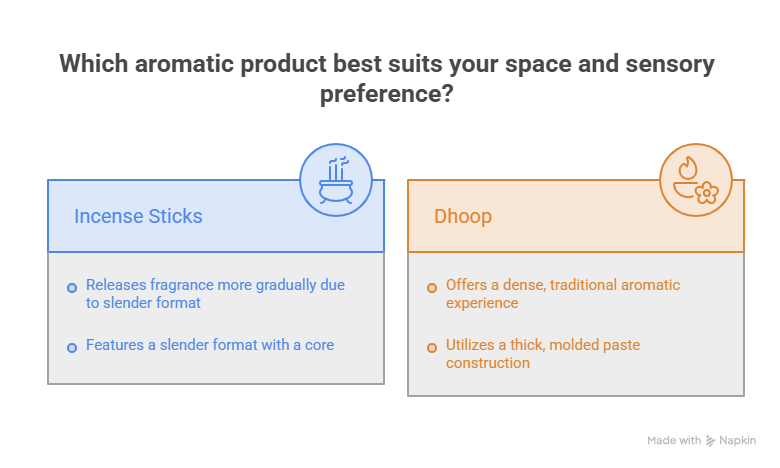
Fragrance is one of the most noticeable factors in an incense vs dhoop comparison. Some dhoop products offer a dense, traditional aromatic experience, while many incense sticks release fragrance more gradually because of their slender format. Yet fragrance strength is determined by more than shape. Ingredients, fragrance concentration, stick dimensions, ventilation and the individual formulation can all influence how strongly a product smells during and after burning.
When evaluating dhoop vs incense sticks, smoke output also deserves attention. A thicker burning product may generate a different amount of visible smoke compared with a slender incense stick, but there are important variations between manufacturers and formulations. It is therefore more accurate to compare individual products instead of assuming that every dhoop product creates more smoke or that every incense stick produces less.
Room size makes the incense vs dhoop choice more practical. A fragrance that feels balanced in a spacious living room may become overpowering in a compact bedroom or enclosed prayer space. Similarly, an aroma that seems subtle in a large room may be quite noticeable in a smaller area. Users should select the fragrance intensity and burning duration according to their environment rather than using the same amount in every room.
For indoor use, the dhoop vs incense sticks decision should include ventilation and basic fire safety. Both are burning products, so place them on suitable heat-resistant holders and keep air circulation in mind. Avoid treating fragrance smoke as an air purifier or medical product. Incense and dhoop are best understood as aromatic products used for fragrance, personal routines and devotional settings rather than treatments for health conditions.
Dhoop for Pooja: When Should You Choose Dhoop or Incense Sticks?
Using dhoop for pooja is a familiar choice in many households because a fuller traditional aroma can complement the atmosphere of a prayer routine. Depending on personal preference, users may select sandalwood, jasmine, rose, woody, floral, musk or other traditional fragrance profiles. The important point is to select an aroma that feels suitable for the prayer space without making it so intense that it becomes uncomfortable.
In a dhoop vs incense sticks comparison for daily worship, dhoop may appeal to someone who prefers a richer fragrance during a shorter dedicated prayer period. Incense sticks can be convenient when a steadier, more gradual aroma is preferred. This makes incense practical for morning rituals, longer prayer sessions or situations where users want a slender format that fits easily into a conventional incense holder.
People choosing dhoop for pooja should also consider room size. A compact prayer room may need only a small amount of fragrance, while a larger open area may accommodate a fuller aromatic profile. The same principle applies to incense sticks for pooja. Users can experiment with fragrance families and burning duration until they find a combination that complements their routine.
The dhoop vs incense sticks choice extends beyond pooja as well. Incense sticks may suit reading, meditation or everyday home ambience when a softer fragrance is desired. Dhoop may suit occasions when a more noticeable aroma is preferred. There is no requirement to use only one format. Some households may keep both incense sticks and dhoop for pooja, choosing between them according to time of day, room conditions and personal preference.
Dhoop vs Incense Sticks: Which One Should You Choose?
Choosing between dhoop vs incense sticks starts with intended use. If you prefer a compact, familiar stick format that releases fragrance steadily, incense sticks may be convenient. If you prefer a thicker or bamboo-free format with a different fragrance and burning experience, a suitable dhoop product may be worth considering. The correct choice depends on the individual product rather than a universal rule.
Fragrance intensity and room size should come next. A stronger traditional fragrance may be enjoyable during prayer but may feel excessive in a small enclosed space. Likewise, a lightly scented incense stick might work beautifully in a bedroom or reading area but feel too subtle in a large hall. Testing smaller quantities can help identify what works before buying larger packs.
Product quality, packaging and storage are also important when evaluating dhoop vs incense sticks. Keep products in a cool, dry place away from excess moisture, heat and strong surrounding odours. Packaging that closes properly helps protect fragrance quality between uses. Buyers should also compare quantity, price, fragrance selection and manufacturer information before choosing.
Ultimately, dhoop vs incense sticks has no single winner. Choose dhoop when you enjoy its format and fragrance experience, and choose incense sticks when their burn style and convenience better suit your routine. For prayer, meditation or daily home fragrance, personal preference should remain central. Explore the LOLAA product gallery to compare available fragrance products and choose according to your preferred aroma and usage.
Dhoop vs Incense Sticks Comparison Table
| Feature | Dhoop | Incense Sticks |
|---|---|---|
| Typical form | Thick sticks, cones, cups or other formats | Usually slender sticks |
| Bamboo core | Often bamboo-free, depending on product | Commonly uses a bamboo core |
| Fragrance intensity | Can be rich or concentrated | Often gradual and steady |
| Smoke level | Varies by formulation and size | Varies by formulation and size |
| Burning style | Depends on dhoop format | Slow smouldering stick |
| Room suitability | Often suited to areas where a fuller aroma is desired | Flexible for prayer rooms and everyday home use |
| Prayer use | Common traditional option | Very commonly used |
| Meditation use | Suitable if fragrance intensity is comfortable | Convenient for a gentle background aroma |
| Everyday home use | Depends on scent strength and ventilation | Commonly used for daily fragrance |
| Ease of use | Holder depends on format | Simple incense holder normally sufficient |
| Fragrance experience | Often fuller depending on formulation | Often gradual depending on formulation |
Frequently Asked Questions
What is the main difference between dhoop and incense sticks?
The main difference is often the product format and construction. Incense sticks commonly use a thin bamboo core coated with aromatic combustible material, while dhoop is frequently bamboo-free and can appear in thicker sticks, cones or cups. Formulations vary, so fragrance strength, smoke and burn time should be checked product by product.
Is dhoop stronger than incense sticks?
Some dhoop products can produce a richer fragrance experience because of their form and aromatic material, but this is not universal. Individual fragrance concentration, dimensions and ingredients matter. Compare the specific products rather than assuming one category will always be stronger.
Is dhoop good for pooja?
Many people use dhoop for pooja because they enjoy its traditional fragrance and burning style. The best option depends on the prayer space, fragrance preference, ventilation and desired intensity. A mild product may suit smaller spaces, while a fuller fragrance may feel appropriate in a larger prayer area.
What is the difference between dhoop sticks and agarbatti?
In a dhoop sticks vs agarbatti comparison, agarbatti commonly has a bamboo core, while dhoop sticks are often thicker and may be bamboo-free. Actual ingredients and construction methods vary by manufacturer, so check the individual product rather than relying only on the category name.
Which is better for home fragrance: incense or dhoop?
The incense vs dhoop choice depends on how strong you want the fragrance to be. Incense sticks can provide a gradual aroma that works well for many everyday settings, while some dhoop products may provide a fuller fragrance. Room size and ventilation should influence the decision.
Can dhoop and incense sticks be used every day?
They may be used as part of a daily fragrance or prayer routine, but users should follow product instructions, maintain appropriate ventilation and use a safe heat-resistant holder. Frequency and duration should also match personal comfort and room conditions.
Which produces more smoke: dhoop or incense sticks?
There is no universal answer because smoke output depends on size, ingredients and formulation. Some thicker dhoop products may create more visible smoke, but individual incense and dhoop products can behave differently. Compare actual product characteristics rather than relying on the name alone.
How should dhoop and incense sticks be stored?
Store both in a cool and dry place away from excess moisture, direct heat and strong surrounding smells. Close the packaging after use so the product is protected from humidity and unwanted odours that could affect its fragrance.
Conclusion: Which Should You Use and When?
The dhoop vs incense sticks decision should be based on how you actually plan to use the product. Dhoop can be an appealing choice when you prefer a fuller traditional fragrance or a bamboo-free format, while incense sticks can be convenient when you want a slender product with a steady fragrance experience.
For pooja, meditation and everyday home fragrance, consider room size, ventilation, fragrance strength and personal preference before choosing. Neither format is automatically better in every situation.
Explore LOLAA Incense Sticks to compare available incense and dhoop options, fragrance styles and formats. For product information, bulk orders or wholesale enquiries, visit the LOLAA product gallery or contact LOLAA Incense Sticks directly.