🔥 ₹425 VALUE @ ₹399 + FREE DELIVERY 🚚 | 🔥 PAY ₹500 & GET ₹600 MRP + FREE DELIVERY 🚚 | 💰 EXTRA 10% OFF ON UPI PAYMENTS

Agarbatti vs Incense Sticks: Is There Any Difference?

If you have ever searched for incense online or walked into a pooja store, you may have wondered about agarbatti vs incense sticks. In everyday Indian use, the two terms are often treated as the same thing because agarbatti is commonly understood as a type of incense stick used for prayer, fragrance and daily rituals.
The question of agarbatti vs incense sticks becomes more interesting when you look at terminology, ingredients and manufacturing styles. “Incense sticks” is a broad English term, while “agarbatti” is widely used in India for scented sticks that are burned to release aroma.
When comparing agarbatti vs incense sticks, it is important not to assume that they are completely different products. In many cases, the difference is mainly in naming, cultural usage, fragrance style, formulation or the way a manufacturer describes the product.
A useful agarbatti vs incense sticks comparison should therefore focus on what you actually receive: the fragrance, stick construction, smoke level, burn quality, ingredients, packaging and intended use. Those factors matter more to most buyers than the wording printed on the packet.
Agarbatti vs Incense Sticks: Understanding the Basic Meaning
The simplest way to understand agarbatti vs incense sticks is to start with the terms themselves. Incense is a broad category of aromatic materials that are burned to release fragrance, and incense products can appear as sticks, cones, coils, powders, resins and other formats.
In India, “agarbatti” commonly refers to a scented incense stick, often made around a thin bamboo core. This is why searches for agarbatti vs incense sticks can be confusing: a product sold as agarbatti in India may simply be described as an incense stick in another market.
The phrase agarbatti vs incense sticks can also reflect cultural language rather than a strict technical difference. “Agarbatti” is familiar in Indian homes, temples and pooja stores, while “incense sticks” is a broader English description understood internationally.
For shoppers, the most practical conclusion from the agarbatti vs incense sticks discussion is that agarbatti is generally a form of incense stick, not a completely unrelated product. What changes from brand to brand is usually the fragrance, composition, thickness, burn performance and overall product experience.
Agarbatti vs Incense Sticks: Ingredients and Manufacturing
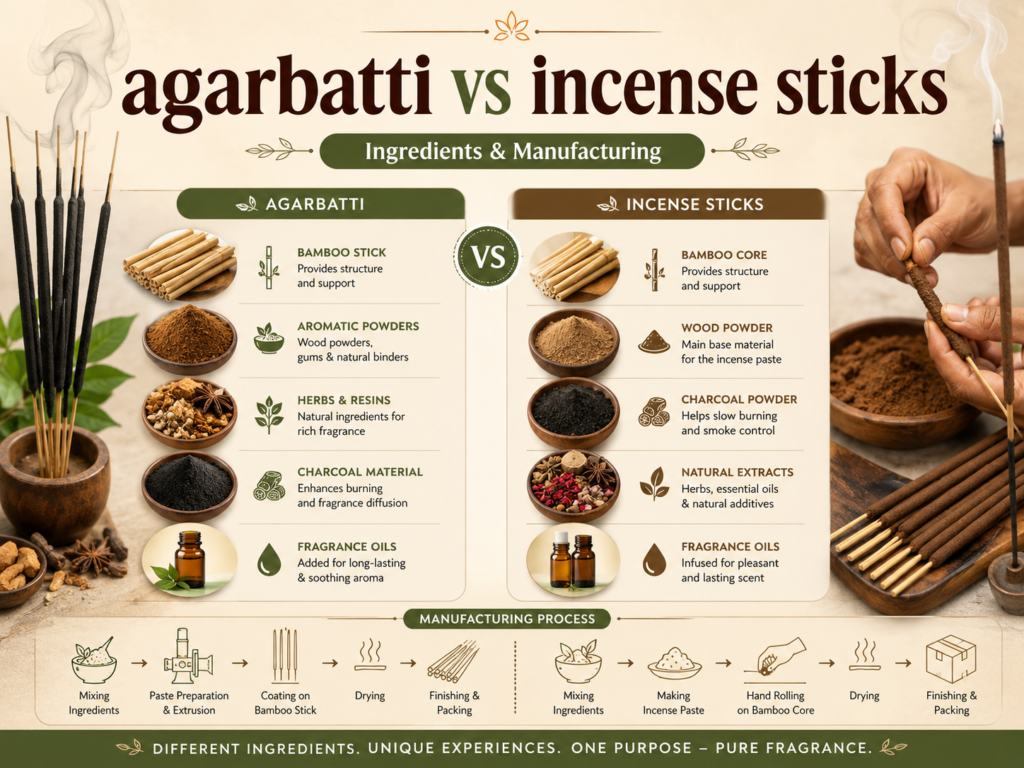
When people research agarbatti vs incense sticks, ingredients are often the first major point of comparison. Many Indian incense sticks use a bamboo core coated with a combustible paste that may contain wood powders, charcoal-based materials, binders and aromatic ingredients.
However, there is no single formula that applies to every product. A meaningful agarbatti vs incense sticks comparison should recognize that manufacturers may use different raw materials, fragrance blends, base powders and production methods depending on the product range.
Some incense sticks are made using a masala-style process, where aromatic materials are incorporated into the coating mixture. Others may be produced as unscented or lightly scented base sticks and later dipped or treated with fragrance. This is one reason agarbatti vs incense sticks cannot be reduced to one universal ingredient difference.
The better way to evaluate agarbatti vs incense sticks is to look at the individual manufacturer and product specification. Check how the product is described, what fragrance style it uses and whether the maker provides clear information about quality and intended use. You can also review the LOLAA About Us page when comparing the brand’s incense products.
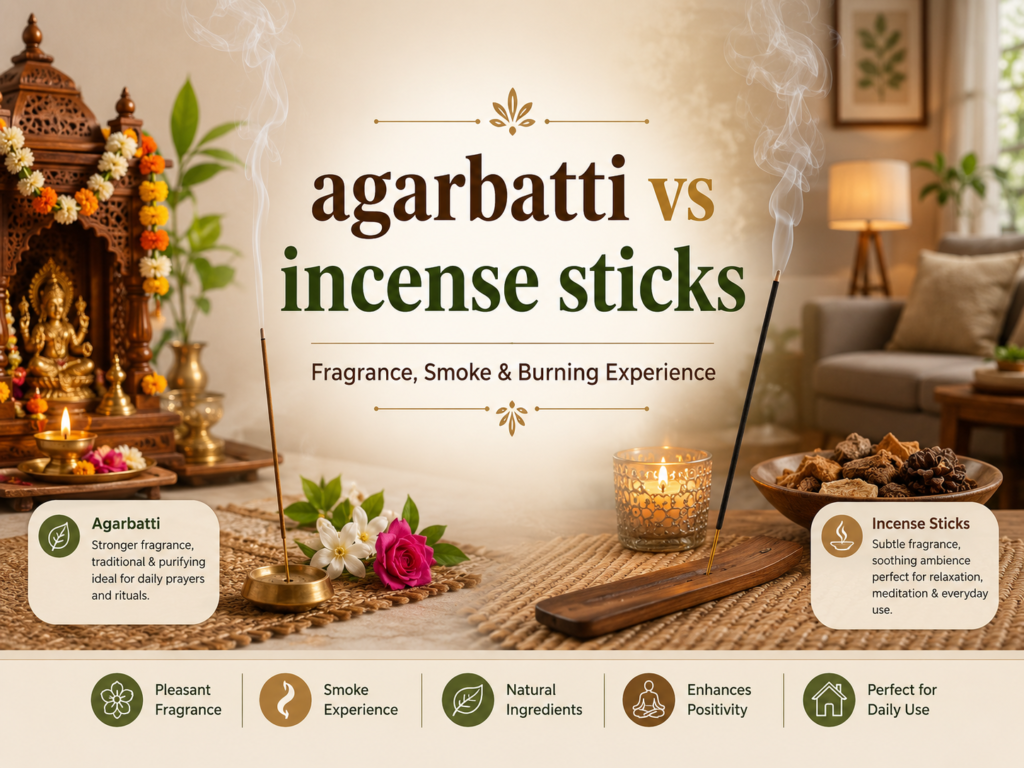
Agarbatti vs Incense Sticks: Fragrance, Smoke and Burning Experience
Fragrance is where the agarbatti vs incense sticks comparison becomes much more practical. Two sticks with similar dimensions can smell very different because fragrance intensity depends on the formulation, aromatic materials and concentration used by the manufacturer.
Burn time is another factor. When considering agarbatti vs incense sticks, check whether the stick burns steadily, whether the aroma develops gradually and whether the fragrance suits the size of the room. A stronger scent may feel suitable in a larger living area but excessive in a compact prayer space.
Smoke output can also vary between formulations. The agarbatti vs incense sticks label by itself does not tell you exactly how much smoke a stick will produce. Stick thickness, coating materials, airflow and the way the product burns can all influence the experience.
For everyday use, a sensible agarbatti vs incense sticks decision should consider ventilation and personal comfort. Use incense in a reasonably ventilated area, avoid placing a burning stick too close to people or fabrics and follow the product instructions for safe use.
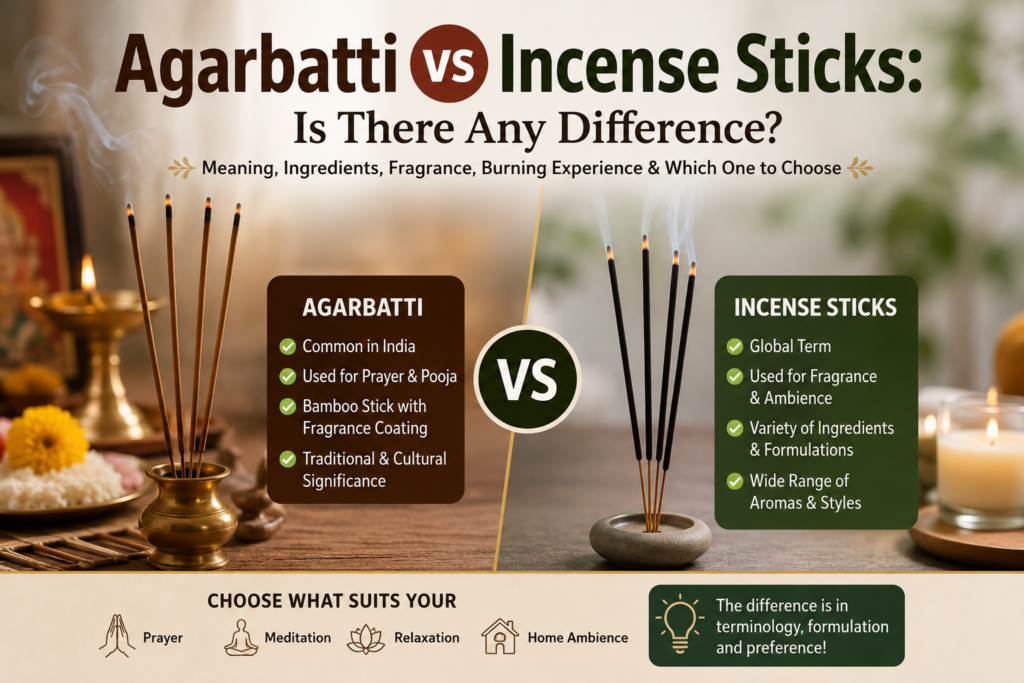
Agarbatti vs Incense Sticks for Pooja, Meditation and Home Fragrance
For many families, the agarbatti vs incense sticks question comes up while choosing products for pooja. In practice, the name matters less than whether the fragrance complements the prayer space and whether the stick burns consistently through the routine.
People who prefer floral aromas may choose jasmine, rose or similar fragrance profiles. Those who enjoy warmer scents may prefer sandalwood, musk or other woody notes. In an agarbatti vs incense sticks comparison for prayer, personal fragrance preference should remain the deciding factor.
The same applies to meditation, reading or evening relaxation. Instead of treating agarbatti vs incense sticks as a choice between two opposing products, consider the aroma strength, burn duration and how noticeable you want the fragrance to be in the room.
For general home ambience, the agarbatti vs incense sticks decision can also change by time of day. A lighter fragrance may work well in the morning, while a deeper traditional or woody aroma may suit an evening routine. You can browse the LOLAA product gallery to compare available incense choices and fragrance styles.
Agarbatti vs Incense Sticks: Which One Should You Buy?
Before buying, remember that agarbatti vs incense sticks is not usually a simple question of one being better than the other. Start by deciding where you will use the product, what fragrance family you enjoy and how strong you want the aroma to feel.
Quality and consistency should come next. When evaluating agarbatti vs incense sticks, look for sticks that are packaged properly, burn evenly and provide the fragrance style you expect. If you are trying a new scent, buying a smaller quantity first can be a practical approach.
Room size, ventilation, smoke preference and storage also deserve attention. The best agarbatti vs incense sticks choice for a spacious living room may not be the same as the best choice for a small pooja area, bedroom or reading corner.
Ultimately, the right agarbatti vs incense sticks purchase depends on the actual product rather than the terminology. Compare fragrance, formulation, manufacturer, burn quality, quantity and value. If you are considering LOLAA Incense Sticks, explore the available collection and contact the brand for product or bulk-order information.
Frequently Asked Questions
Is agarbatti the same as an incense stick?
Agarbatti is generally understood as a type of incense stick, particularly in India. The word “incense” is broader and can also refer to cones, coils, resins, powders and other aromatic products that are burned.
Why is incense called agarbatti in India?
“Agarbatti” is a widely used Indian term for scented incense sticks used in homes, temples, prayer spaces and other settings. “Incense stick” is the broader English description used in many international markets.
What is agarbatti made from?
The exact ingredients vary by manufacturer. Many products use a bamboo core with a coating that can include wood or plant powders, charcoal-based materials, binders and fragrance ingredients.
Some products use different construction methods, so it is better to check the specific manufacturer or pack information.
Which is better: agarbatti or incense sticks?
There is no universal winner between the two terms. Since agarbatti is commonly a form of incense stick, buyers should focus on fragrance, burn consistency, smoke preference, ingredients, packaging and intended use.
Can incense sticks be used for everyday home fragrance?
Yes, many people use incense sticks as part of a daily home-fragrance routine. Choose a fragrance strength that suits the room, avoid making the scent overpowering and maintain suitable ventilation while the incense is burning.
How should incense sticks be stored?
Keep incense in a cool, dry place away from moisture, direct heat and strong surrounding odours. Closing the pack properly after use can help preserve fragrance and keep the sticks in better condition.
Conclusion: Understanding Agarbatti vs Incense Sticks
The agarbatti vs incense sticks comparison is mainly about terminology, product format and regional usage rather than two completely separate categories. In India, agarbatti commonly refers to the familiar scented stick used for pooja, home fragrance and daily rituals.
When choosing between products, let the terminology guide your search, but make the final decision based on fragrance, formulation, burn quality, smoke preference and room conditions. A product that suits your personal routine is more useful than choosing only by name.
If you are exploring incense products for home, prayer or bulk requirements, compare different fragrance profiles before deciding. Explore LOLAA Incense Sticks to view available options and choose a product that matches your intended use.
For product information, wholesale requirements, distributor enquiries or bulk orders, visit the LOLAA product gallery and Contact Us page.